
AC drain pan overflow and ceiling damage in Round Rock, TX
It usually starts as one thing going wrong in the attic and ends as two separate calls downstairs.
Call 24/7(737) 734-396624/7 emergency line. Free estimates from local pros.
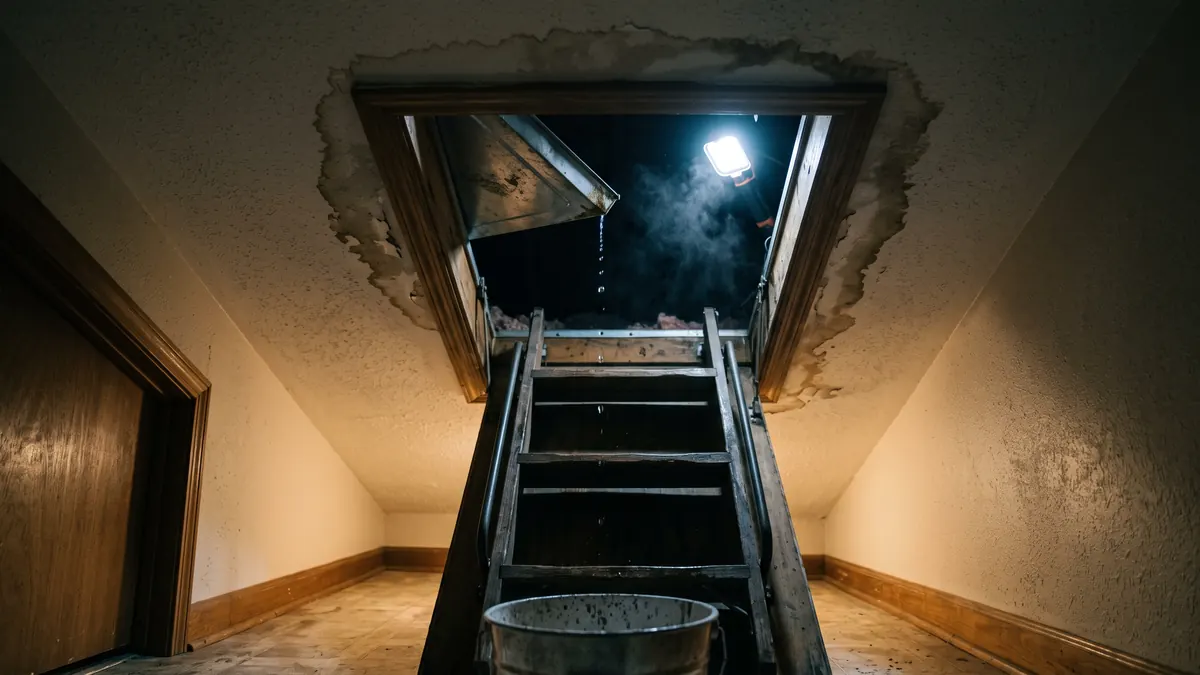
An AC drain pan overflow means the condensate a Central Texas air conditioner makes all summer stopped draining the way it’s supposed to, and started spilling into the attic instead. Most people find out the same way, on an ordinary afternoon: a spot shows up on the ceiling, or the AC itself starts acting off.
The afternoon it shows up
It rarely announces itself. The air feels a little warmer than it should, or someone notices a faint discoloration on the ceiling below the attic unit while walking past. Neither one screams emergency at first glance, which is part of why it goes unnoticed as long as it does. By the time either sign is obvious enough to act on, water has usually been finding its way past the pan for a while.
What the attic actually shows
Climb up with a flashlight and the story is usually right there. The pan under the air handler is holding standing water instead of sitting dry. Or the drain line is backed up instead of running freely toward the outside wall. Insulation right under the unit is often damp to the touch, sometimes matted down where water sat on it. None of that takes a trained eye to spot; it just takes actually looking.
Why the pan fills in the first place
An air conditioner pulls a lot of moisture out of humid Central Texas air while it runs. That water has to go somewhere. Under normal conditions, it drips into the pan and drains out through a narrow line, day after day, without anyone noticing. Algae and dust build up inside that line slowly, over months, until it narrows enough to back up. A lot of systems also carry a small fail-safe wired into the pan, meant to shut the unit down before things get out of hand. That fail-safe only helps if it’s still working, and plenty aren’t, either because it’s old, or because it was never wired in correctly to begin with.
The HVAC call and the water call
By the time you’re back downstairs, there are usually two different calls worth making before this is done. One goes to an HVAC company, for whatever’s actually broken up there: a clogged line that needs clearing, or a fail-safe that needs replacing. The other is for what all that water did once it found its way past the pan, which is a different kind of job entirely. Treating both as the same call tends to leave one of them undone.
What the water reaches on the way down
Once the line’s clear, the ceiling and whatever sits above it become a separate problem. The ceiling water damage page irons out how a stain, a sag, and an active drip each read once you’re standing under one. AC overflow is one of the three usual suspects there. Drying time depends on how much insulation and drywall actually got wet. The drying time guide scopes out that range in plain terms. And does a failed part count as sudden damage, or as something that built up for months? That one belongs to the homeowners insurance guide, not this page.
The smell usually gets there first
Long before a stain is visible from the room below, a musty edge near a vent or return grille is often the first real sign something’s wrong overhead. It’s easy to blame on a dusty filter and move on. Catching it before a ceiling spot ever forms is the cheapest version of this whole problem, since it means checking the attic before drywall and insulation are already soaked.
Common questions
Is it safe to keep the AC running once you've spotted water in the pan?
Turning the unit off until the line's cleared is the safer call. Running it longer just adds more water to a pan that's already struggling to drain, which is exactly what pushes it over the edge into the ceiling below.
How do you tell a normal amount of pan water from an actual clog?
A little water sitting in the pan after a hot afternoon is normal; the coil is always shedding some. A pan that stays full, or water backing up the line instead of draining out of it, points at a real clog rather than routine condensation.
Does the HVAC company also dry out the ceiling once the line's clear?
Usually not. Clearing the line or replacing a failed part is HVAC work, aimed at stopping more water from coming through. Drying out wet insulation, drywall, or a ceiling that's already stained is a separate job, and it's worth getting both handled instead of assuming one call covers the other.
Is a small ceiling stain from this worth reporting to insurance?
That comes down to your deductible and how you feel about opening a claim, not a fixed rule. A part that fails without warning tends to read as an accident to most insurers, but coverage always depends on the specific policy, so it's worth asking rather than guessing either way.
Related pages
Drying Time
Most jobs run several days, and the questions people ask usually come up on day two or three.
Learn more →Frozen Pipe Burst
An ordinary freeze and a week-long one break pipes for the same reason, and the prep list is exactly the same either way.
Learn more →Insurance Guide
Texas homeowners policies pay for some water damage and skip the rest, and four plain factors decide which side of that line you land on.
Learn more →Mold after water damage
How fast mold shows up depends on how long things stayed wet, and this problem really has two separate phases, not one long one.
Learn more →Talk to a local pro now
We answer 24/7. One call gets a Round Rock crew moving on your water damage, with a free estimate and help with your insurance claim.
Call 24/7(737) 734-3966Free estimates. No obligation to hire.